Wednesday, April 21, 2010

WP3 Draft 1

Dear Birth of Venus,

Do you know where you got your name? “Birth of Venus” is not unique. It is not original. It is the name of a painting done in the 1400s by Sandro Botticelli. Your name is a direct reference to this painting. This painting shows the goddess Venus, rising up out of the water, surrounded by angels. Venus, the Roman goddess of love and beauty, is shown as a beautiful woman in this painting and countless other classical works of art depicting her. Ancient sculptures like “Venus de Melo” and “Venus de Medici" show a grown woman, perfect in form and features. Beautiful. Flawless. This is the Venus people know. This is what people expect when the name “Venus” comes to mind. A goddess. Perfection. Your name demands that you be beautiful.

But Birth of Venus, you are not beautiful. You are not flawless. You are not perfect. You are the farthest thing from the image of a goddess. You are grotesque. Flawed. Imperfect. Some might even go so far as to call you ugly. You are average in every way imaginable. You are probably even below average. At first glance, there is absolutely nothing special about you. How can you be the complete polar opposite of your namesake? Why were you named after something that you have nothing in common with?

You were named after that Venus because you are so different. Your name draws attention to the juxtaposition between the idealistic beauty of the gods and the realistic normalcy of everyday life, and these differences are important. By naming you after the painting, it not only demands that you be beautiful, it demands that you be compared to it. People hear your name and compare you to this goddess, this epitome of beauty and perfection. They hold you to her, and note the stark differences between the two.

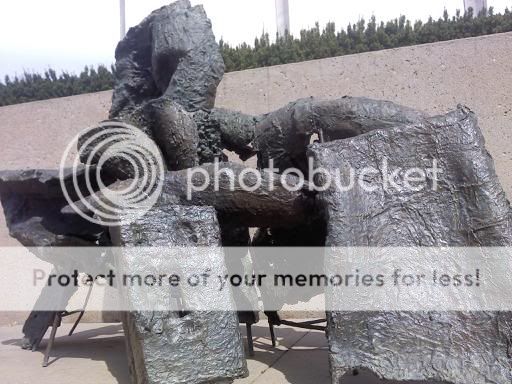
And how can you even compare to her? You don’t even look human. Honestly, it’s really hard to tell what you do look like. You are so complex, so…different. You are a complicated mass of bronze pieces welded together. You’re hard to figure out. A scaffold of metal pipes is all that holds you up and keeps you in tact, and the pipes are completely visible to anyone looking at you, connecting all your individual pieces like some crude skeleton. Each piece is completely unique—different size, shape, and texture, even different colors where the bronze has turned a greenish hue. Each fold and curve in the metal creates different shadows that fall on different places, and even that is different depending on the time of day.

One of the pieces is higher than the rest of you, like it’s rising up out of the wreckage that makes up your body. This is what people’s eyes are drawn to when first looking at you. This is what we notice. Why is this piece of you so important? Is this your face? Are you looking back at us? This is nothing like the smooth pale face of the Venus in the painting, with her golden hair falling behind her. This is different.

Another important difference between you and the Venus that you were named for is that you are very real. We can see and touch and feel you. We can walk around you and observe you in all your dimensions. An ancient myth, an old painting—these things aren’t real for us. We know about them, we can look at pictures of them, but they are not here right in front of us like you are. And because you are here right in front of us, we are able to really get to know you. We can look all around you, and each time we look at you, we see something different. Certain parts of you are visible only from certain angles, and other parts of you look different as the onlooker stands in a different spot. You have more to you than what initially meets the eye. You have depth. It’s impossible for someone to stand in one spot and think that they really understand you.

This is why you are appealing to people. People can relate to you. You’re a better example for us than some fictional ancient goddess. You are like us. People aren’t flat and one-dimensional. People aren’t transparent and easy to understand. People aren’t always who or what they appear to be. People take time to get to know and to figure out. We as people are complicated and unique and difficult, just like you are.

And this, Birth of Venus, is where your beauty becomes evident. See the goddess Venus was just that: a goddess. She was not human. She could be perfect. We on the other hand are not. Humans are inherently flawed; true perfection is impossible. You, Birth of Venus, you are human. You represent all of our flaws, mistakes, and imperfections. You are an example of something we can relate to, something we can strive for. You show us how we can be beautiful despite all our faults, because you are beautiful. You are an art object. People come look at you, admire you. We can see your obvious flaws—your asymmetry, your rough textures, and your abstract figure—but still appreciate you. We can look past these flaws and still find beauty inside you. Beauty is not defined as perfection, because really, nobody is perfect, and yet the world is full of beauty. You just have to know how to see it.

Sincerely,

Cara Anderson

Monday, April 19, 2010

WP3 Statement of Purpose

For Writing Project 3, I will be writing a letter to Reuben Nakian's sculpture, "The Birth of Venus." As stated in the project guidelines, the letter will need to include observations, reflections and insights and how those relate to a specific aesthetic or concept. Another major part of my letter will be the historical and contextual background information about both the goddess and the painting that the sculpture references.

I will be presenting this letter in two different ways. First, I will be posting it online on my blog. This medium will allow me to include multimedia elements such as pictures, and I will also be able to include hyperlinks that will enable my audience to gain more outside information that doesn't directly pertain to my writing. This will be beneficial because it may help the audience better understand the letter.

Posting it online will also make my letter reach a broader audience. As with the first two writing projects for this class, my primary audience for Writing Project 3 will be my teacher. He is the primary audience because he is grading this assignment, and because I want to get a good grade, I will have to make sure that my letter is done correctly and follows the guidelines and also is a good piece of writing. Since all my classmates are doing similar assignments and our teacher will be reading all of them, I want to make my letter stand out from the others. Hopefully, this will make my letter unique and more interesting so it will be something my teacher will enjoy reading.


A secondary audience is my classmates. Our blogs are all linked together, so it will be really easy for current and future English 151 students in this class to reach. They might want to use mine as an example of the writing project, so again I need to make sure that my letter is done correctly and done well. Additionally, anybody with access to the Internet could potentially read my letter, especially someone looking for information on my specific sculpture. This will mean I have to present all my information accurately.

Besides posting it online, I will also be reading my letter out loud to the sculpture. My primary audience for this will be the sculpture. Sculptures are inanimate objects, specifically art objects, and therefore can't hear or understand what I'm reading to it, but I'm going to read the letter as though the sculpture could understand it. This will be a unique challenge because I've never written a letter to an object so it will be a new experience. Secondary audiences for this part of the assignment will again be my teacher and classmates, as well as anyone who happens to walk by during my presentation.

The context in which I will be presenting my letter is in the outdoor sculpture garden of the Sheldon Art Gallery, so there will likely be distractions. In order to engage the audience, I will have to do more than simply just read the letter. I will have to use aspects of oral communication to engage the audience and make my letter more effective and interesting. This may include tone, inflection, volume, and pace of speaking, body language and gestures, and facial expressions and enthusiasm for my project.

Saturday, April 17, 2010

WP3 Pre-Writing 4

The sculpture I am using for Writing Project 3 is based on a painting by Sandro Botticelli with the same name, "Birth of Venus." The painting shows a woman, the goddess Venus, standing in a shell next to the ocean with angels flying around her. The painting depicts the myth that Venus was born when she emerged from the sea as a grown woman.

This painting draws heavily on Roman mythology. Venus was the Roman goddess of love. She was also associated with beauty and fertility, and is the equivalent of the Greek goddess Aphrodite. She is often shown in art as a beautiful young naked woman with cherubs and doves flying around her, and the Botticelli painting is a prime example of this. Venus is also shown in a similar fashion as the famous sculptures "Venus de Medici" (shown at right) and "Venus de Melo," large marble sculptures of the Greek goddess Aphrodite, made in the first century B.C. All these early examples of Venus show the typical ideal of beauty.

Reuben Nakian, born in 1897 in New York, was the artist that created the sculpture "Birth of Venus," and like Botticelli, a central theme of his is mythology. Many of his works are based on and named after references to mythology, but unlike Botticelli's works, they are not the traditional depiction of the mythological legends. As his "Birth of Venus" shows, Nakian's works are a sharp contrast to the paintings and figures they are referencing. They are "based on the radical abstraction of the female form as a way to transcend mere appearance to address more primal, essential issues." (http://rogallery.com/Nakian_Reuben/nakian-biography.htm) They are drastically different that the "normal" perceptions of women and beauty, but doing this undermines the perfection of the ancient goddesses. The abstraction draws attention to and normalizes human flaws, showing that not everyone is flawless and perfect.

Wednesday, April 14, 2010

Wp3 Pre-Writing 3

The sculpture "Birth of Venus" has a lot of interesting characteristics that employ rhetorical concepts and appeals within the art object. The sculpture is a very complex and intriguing piece with a lot going on visually, and as a result, the audience has to think about it more in order to really understand it.

One concept that is important in this sculpture is perspective. This affects the audience in that the structure of the sculpture provides an appeal to pathos. Because of the complicated structure of "Birth of Venus" and the many pieces that make up the sculpture, the audience can see it differently from varying angles. Since it is a three-dimensional piece of art, it looks different depending on where the audience is looking at it from. Certain parts are only visible from certain points, and as the viewer moves around the sculpture, different things come into view. This is important if one is to really take in and try to understand the sculpture as a whole. How the audience perceives the sculpture might affect how they see and understand it.

Another appeal is that the form of the sculpture itself evokes pathos within the audience. It is not the perfect image of beauty, as the Roman goddess Venus is depicted in the painting "Birth of Venus." Instead, the sculpture is imperfect and grotesque. Its flaws are magnified and very obvious to anyone who looks at the art, and that creates an emotional appeal with the audience because people, like the sculpture, are far from perfect. The Venus depicted in the painting is not realistic at all, so the sculpture provides a stronger connection with the audience because it is a more realistic demonstration of life, and it is something the audience can better relate to. Because the audience can relate to this piece of art, they may be more likely to appreciate it and enjoy it.

Monday, April 12, 2010

WP3 Pre-Writing 2

"Birth of Venus" is a bronze sculpture created by Reuben Nakian from 1963 to 1966, and was cast in 1969. It was based off a painting by the same name by Sandro Botticelli that was done circa 1486. The painting shows a woman, the goddess Venus, standing in an open shell. According to Roman mythology, Venus was born when she emerged from the sea as a grown woman. The Botticelli painting and the Nakian sculpture both incorporate this story, although the sculpture is much more abstract.

This sculpture is pretty interesting to look at because there are a lot of details. At first, it doesn't look like much is going on--it appears to be depicting just a pile of rocks or something. It is a really abstract sculpture, so it's hard to tell what it is exactly, but after looking at it for a while, it's easy to notice a lot of different things.

One of the first things I noticed was the color of the sculpture. It is made of bronze, so it is mostly brownish, but looking at it closer, there are a lot of greenish hues. These green hues stand out a lot more and are more noticeable later in the day when it is getting dark. In the afternoon when it is sunny, the sun reflects off the sculpture, making it look bright and shiny.

Another unique aspect of the sculpture is that it is made of several different sections and pieces that are all different. There are many levels and depths to the sculpture, but everything is connected. You can even see the bars that provide the framework for the sculpture at the bottom and behind it, almost like scaffolding. At first I wasn't sure if the bars were part of the sculpture or if they were just help to support it, but when looking at the back of the sculpture, I think they are mostly for framework. From the back of the sculpture, you can see that all the pieces are open and hollow, not enclosed and all the bars are clearly visible.

Among the different levels, there is a piece that is clearly above the rest of the sculpture. Because of this break in the alignment, there is a visual hierarchy in the sculpture. The viewer notices this part first, and this emphasizes the importance of this part. It appears to be "rising" out of the bottom part of the sculpture, and if compared to the painting, this part represents Venus that is coming from the water.

The texture of the sculpture is another important aspect of the art. It is very rough, and at first glance, it looks like it's made of bronze rocks. There are holes in the bronze all over the sculpture, and some of them look almost accidental, as if they're there as a result of the sculpture being outside for a long time. This gives "Birth of Venus" the appearance of being old and worn. It is not flawless art, but appears to be weathered and imperfect.